Ask a New Yorker their phone number and watch their reaction when you notice the 212. There's a flicker of pride there — and they know exactly why. Across the country, certain area codes have accumulated decades of status, functioning less like routing digits and more like zip codes for your identity. This guide ranks the most prestigious area codes in America, explains what makes each one valuable, and tells you what that prestige is actually worth in the market.
What Makes an Area Code "Prestigious"?
Prestige isn't random. It clusters around a few consistent factors:
- Age and scarcity — The original 1947 North American Numbering Plan assigned low-digit codes to the most populous regions. Those numbers are now rare and tightly held.
- Geographic association — Certain cities and neighborhoods carry outsized cultural weight. The area code inherits that weight.
- Business signaling — A local code in a major financial or media hub tells clients you're planted there, not dialing in from a remote suburb.
- Supply vs. demand — Overlay codes (like 929 layered over New York) create abundance. The original code becomes scarcer by contrast, which drives perceived value.
No single factor explains prestige on its own. It's the combination that separates a truly coveted code from one that's just geographically convenient.
The Most Prestigious Area Codes in America, Ranked
1. 212 — Manhattan, New York
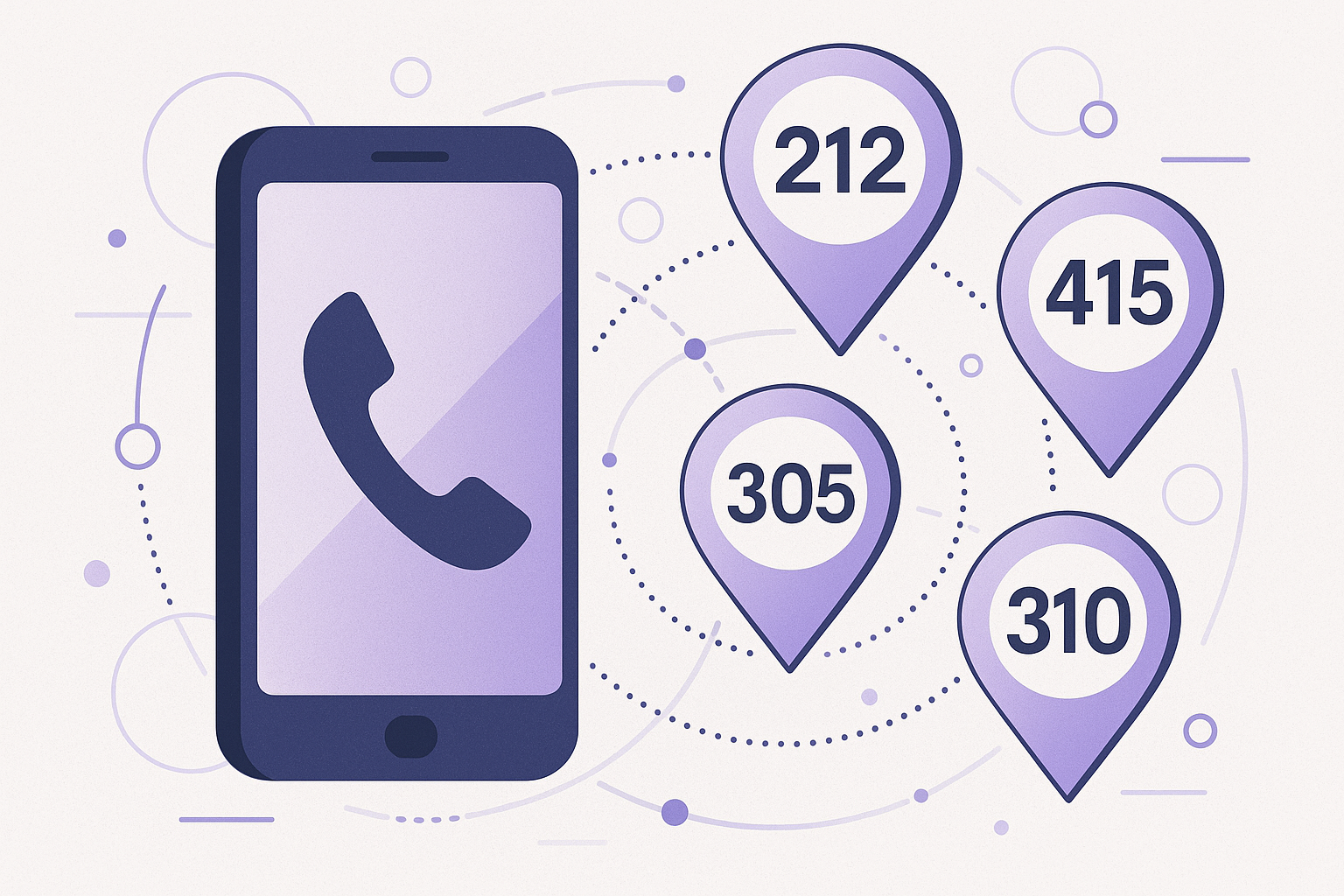
Nothing tops 212. It's the original New York City code, assigned in the very first wave of the numbering plan because New York had the highest call volume in the country. Today, with overlays 646 and 917 flooding the market with numbers, a genuine 212 is genuinely scarce. Vanity 212 numbers trade for anywhere from a few hundred dollars to well over $10,000 depending on the pattern. Wall Street firms, media companies, and law partnerships treat a 212 number as a credibility signal — the phone-number equivalent of a Park Avenue address.
2. 310 — West Los Angeles, California
Beverly Hills, Santa Monica, Malibu, Bel Air. The 310 covers the affluent west side of LA with an accuracy that almost seems intentional. Entertainment industry contacts, talent agencies, and luxury real estate brokers cluster here. When 424 was introduced as an overlay, demand for existing 310 numbers went up, not down. Premium 310 numbers routinely sell in the $500–$5,000 range.
3. 202 — Washington, D.C.
Washington has only one area code, which means every number — whether it belongs to the White House press office or a K Street lobbying firm — carries the same 202. There are no overlays, no dilution. That single-code monopoly gives 202 a clean authority that no other major city can match. If you're doing business in federal policy, law, or government contracting, a 202 number isn't optional.
4. 415 — San Francisco, California
The original San Francisco code predates Silicon Valley by decades, but tech money has retroactively polished it. VCs in the Financial District and legacy firms in the city proper hold onto 415 numbers even as the Bay Area sprawled into 510, 650, and 408 territory. A 415 number signals roots in the city itself, not the broader tech corridor — a meaningful distinction in a region where geography is identity.
5. 312 — Chicago's Loop and Near North Side
Chicago is a big city, but 312 is not a big-city code — it covers only the dense commercial core: the Loop, River North, Gold Coast. The suburbs and outlying neighborhoods fall under 773, 847, 630, and others. That geographic concentration makes 312 the rare case of an area code that functions almost like a neighborhood designation. Law firms, financial institutions, and media companies based downtown covet it accordingly.
6. 305 — Miami, Florida
Miami's original code covers Miami-Dade County and carries the cultural weight of decades of international business, Latin American finance, and luxury real estate. With 786 as its overlay, original 305 numbers are increasingly difficult to acquire through normal channels. It's the go-to code for businesses wanting to signal a genuine Miami presence rather than a forwarded line.
Honorable Mentions
- 213 — Downtown Los Angeles; older and rarer than 310 in some circles
- 404 — Atlanta's original code, dominant in music, finance, and media in the Southeast
- 617 — Boston; the academic and biotech corridor's first choice
- 702 — Las Vegas; hospitality and gaming industry standard
What These Numbers Actually Cost
Prestige has a price. On the secondary market — where numbers are legally ported and sold between businesses and individuals — patterns matter as much as the area code itself. A plain 212 number with no memorable pattern might go for $200–$400. A 212 number with a repeating or sequential sequence (think 212-555-5500 or 212-888-8888) can clear $5,000–$15,000. The same logic applies across all the codes above: the rarer the code, the more a great pattern is worth.
The floor for any of these codes is higher than a generic regional number. A 212 with no pattern still outprices a 718 with a great one in most buyers' minds.
A Concrete Example
A boutique consulting firm opening a New York office has two realistic options: acquire a 212 number on the secondary market for around $800, or get a 646 number instantly for free through their carrier. Several of their target clients — private equity funds, law firms — still associate 646 with mobile lines and newer entities. The 212 costs $800 once and signals something the 646 simply doesn't. For that firm's positioning, the math is straightforward.
Does Prestige Still Matter in a Mobile-First World?
Yes, and here's why: caller ID has made the first impression instant. Before you answer, you see the number. For outbound sales, client calls, and press inquiries, a recognizable high-status area code gets answered at a higher rate. Prestige area codes function as passive marketing — they work every time your number appears on a screen, without any additional effort from you.
Quick Takeaways
- 212 is the gold standard — scarce, Manhattan-specific, and widely recognized as the most prestigious area code in America
- 310, 202, 415, and 312 round out the national tier-one list
- Prestige is driven by scarcity, geography, and cultural association — not just familiarity
- Secondary market prices range from a few hundred to five figures depending on pattern quality
- A prestigious area code pays dividends on every outbound call through improved answer rates and brand perception
- Overlay codes reduce supply of originals, which tends to increase their value over time
If you want to see what's available — whether you're after a 212, a 310, or a 404 with a pattern worth remembering — browse area codes and available numbers on GreatNumber.