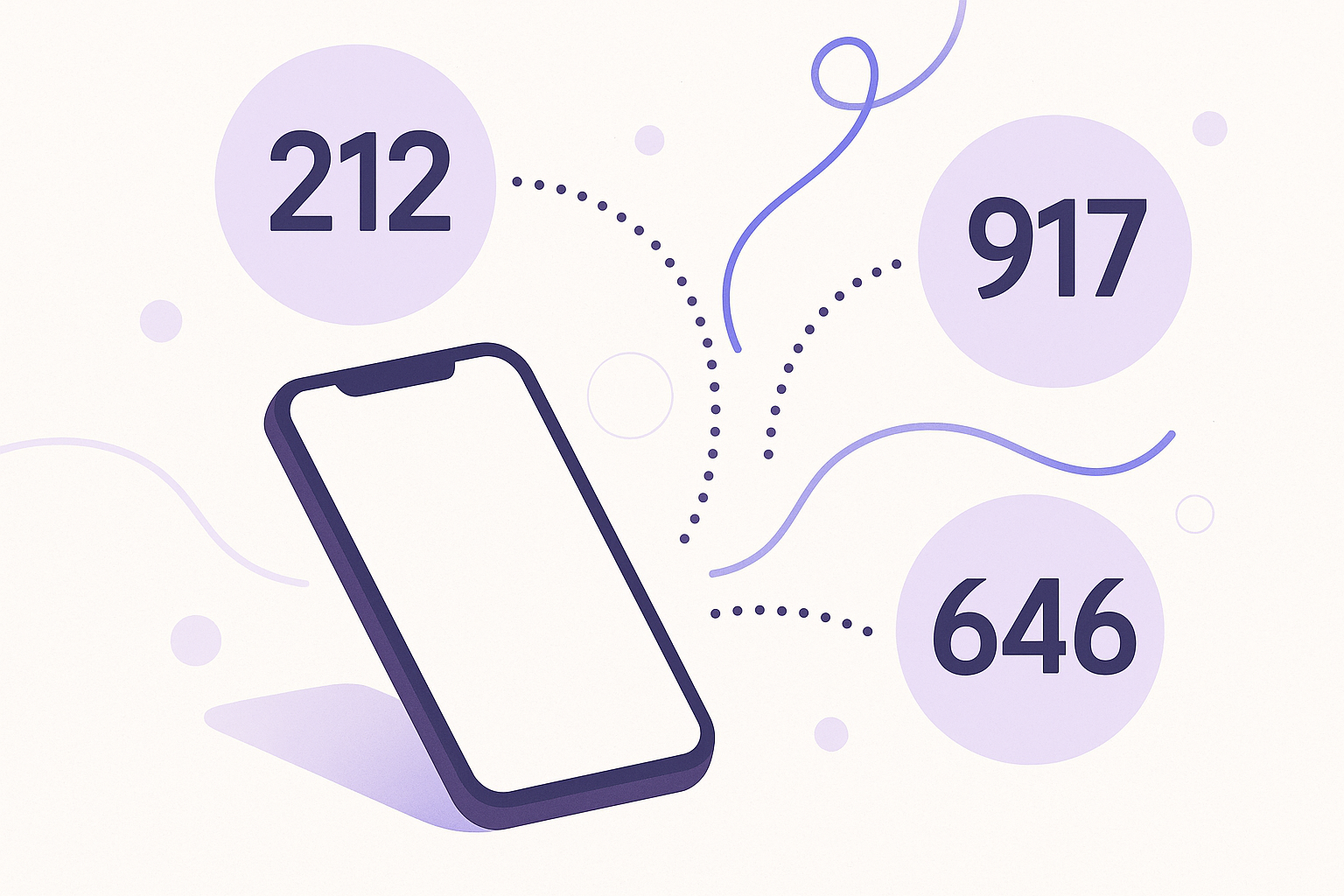
A Manhattan hedge fund manager once told a recruiter to ditch his 646 cell number and get a 212 before his next client pitch. That's an extreme take — but it's not fiction. The debate over 212 vs 917 vs 646, which NYC area code carries the most clout, is older than the iPhone and still very much alive in boardrooms, on Etsy storefronts, and in casting agencies across the five boroughs.
Here's the unvarnished breakdown.
A Quick History of NYC's Three Area Codes
New York City spent decades under a single area code: 212. It covered all five boroughs from the rotary-phone era right up until 1984, when 718 was split off to serve Brooklyn, Queens, the Bronx, and Staten Island, leaving 212 as Manhattan's exclusive territory.
The explosion of mobile phones and fax lines in the late 1990s created a second wave of exhaustion. 917 launched in 1992, initially as a "unified" code layered on top of the entire city for pagers and cell phones. Then 646 arrived in 1999 as a pure overlay for Manhattan landlines and VoIP numbers when 212 supplies ran thin.
The result: three codes, one city, wildly different reputations.
What Each Area Code Actually Signals
212 — The Original Manhattan Code
212 is the prestige play. Because it predates the cellular age, every 212 number was originally a hardwired Manhattan landline. That scarcity — there are only 7.9 million possible 212 combinations, and the most desirable patterns were claimed long ago — is exactly why the code carries weight.
Industries where 212 still moves the needle: finance, law, PR, real estate brokerage, talent agencies, luxury retail. If your clients are C-suite or old-money, a 212 number signals you've been around, or at least that you invested in looking like you have.
The catch: availability is extremely limited. You won't find a 212 number at your carrier's storefront. They trade on secondary markets, sometimes for hundreds or even thousands of dollars depending on the pattern.
917 — The Mobile-Native New Yorker
917 is the code that grew up with cell phones. When someone hands you a 917 number, you instinctively think mobile — because historically, that's exactly what it was. It's also the code with the broadest geographic reach, technically covering all five boroughs (plus some outlying areas under overlapping plans).
For creatives, freelancers, tech workers, and anyone under 45, 917 reads as authentically New York without the stuffiness of 212. It's not a "lesser" code — it's just a different flavor. And premium 917 numbers with repeating or sequential patterns (think 917-555-7777 or 917-800-8000) do command real money on the secondary market.
646 — The Underdog With a Practical Argument
646 gets the least respect, but the criticism is mostly snobbery. It's a straightforward Manhattan overlay, widely available, and functionally identical to 212 or 917 for calls and texts. VoIP providers and virtual phone systems hand them out freely.
Where 646 works well: small businesses that just need a local New York presence without spending extra, remote workers who want a Manhattan number for credibility, and startups that haven't yet decided whether they're staying in New York long-term.
646 is the pragmatist's choice — cost-effective, easy to get, unmistakably New York.
Side-by-Side Comparison
| 212 | 917 | 646 | |
|---|---|---|---|
| Launched | Pre-1984 | 1992 | 1999 |
| Original use | Manhattan landlines | City-wide mobile/pager | Manhattan overlay |
| Prestige factor | ★★★★★ | ★★★☆☆ | ★★☆☆☆ |
| Availability | Very scarce | Moderate | Abundant |
| Typical cost (vanity/premium) | $200–$2,500+ | $50–$500 | $10–$100 |
| Best fit | Finance, law, luxury | Mobile-first, creatives | Startups, small biz, VoIP |
Costs reflect secondary-market premium numbers; standard carrier assignments for 646 and some 917 numbers can be free or near-free.
The Real-World Decision Framework
Ask yourself three questions:
-
Who are your clients? If you're pitching institutional investors or established law firms, the 212 premium may pay for itself in first impressions. If you're a freelance photographer or a Williamsburg coffee brand, it probably won't matter.
-
How do people reach you? If 90% of your inbound calls come through Google or a QR code, the area code is nearly invisible. If you're printing it on a business card that a 60-year-old CFO will hold in their hands, it matters more.
-
What's your budget? A great vanity 646 number — say, 646-200-2000 — is legitimately memorable and won't cost you four figures. A mediocre 212 number with no pattern recognition offers prestige without memorability. Memorability is usually the smarter investment.
A concrete example: A boutique M&A advisory firm in Midtown pays $800 for a clean 212 number with a repeating pattern. A Brooklyn-based UX design studio grabs 646-DESIGN-1 through a VoIP provider for under $50/year. Both decisions are correct for their respective audiences.
Common Myths, Debunked
- "917 is only for cell phones." Not anymore. VoIP providers assign 917 numbers to landlines and virtual systems routinely.
- "646 tells people you're not a real business." It tells people you're in Manhattan. That's it.
- "212 guarantees credibility." A 212 number answered by a rude receptionist does nothing. A 646 number with a great customer experience beats it every time.
Quick Takeaways
- 212 is scarce, prestigious, and expensive — worth it in industries where old-school signals matter.
- 917 reads as authentically New York and covers all five boroughs; premium patterns hold real market value.
- 646 is practical, available, and underrated — perfect for businesses that just need a solid NYC presence.
- Area code prestige matters most in finance, law, and luxury sectors; in most other industries, memorability beats history.
- You can mix strategy: use a 212 or 917 for your main line, a 646 for a secondary department or campaign number.
If you want to browse what's actually available across all three codes — including repeating patterns, easy-dial sequences, and toll-free alternatives — GreatNumber's area code directory lets you search and compare real inventory without the guesswork.