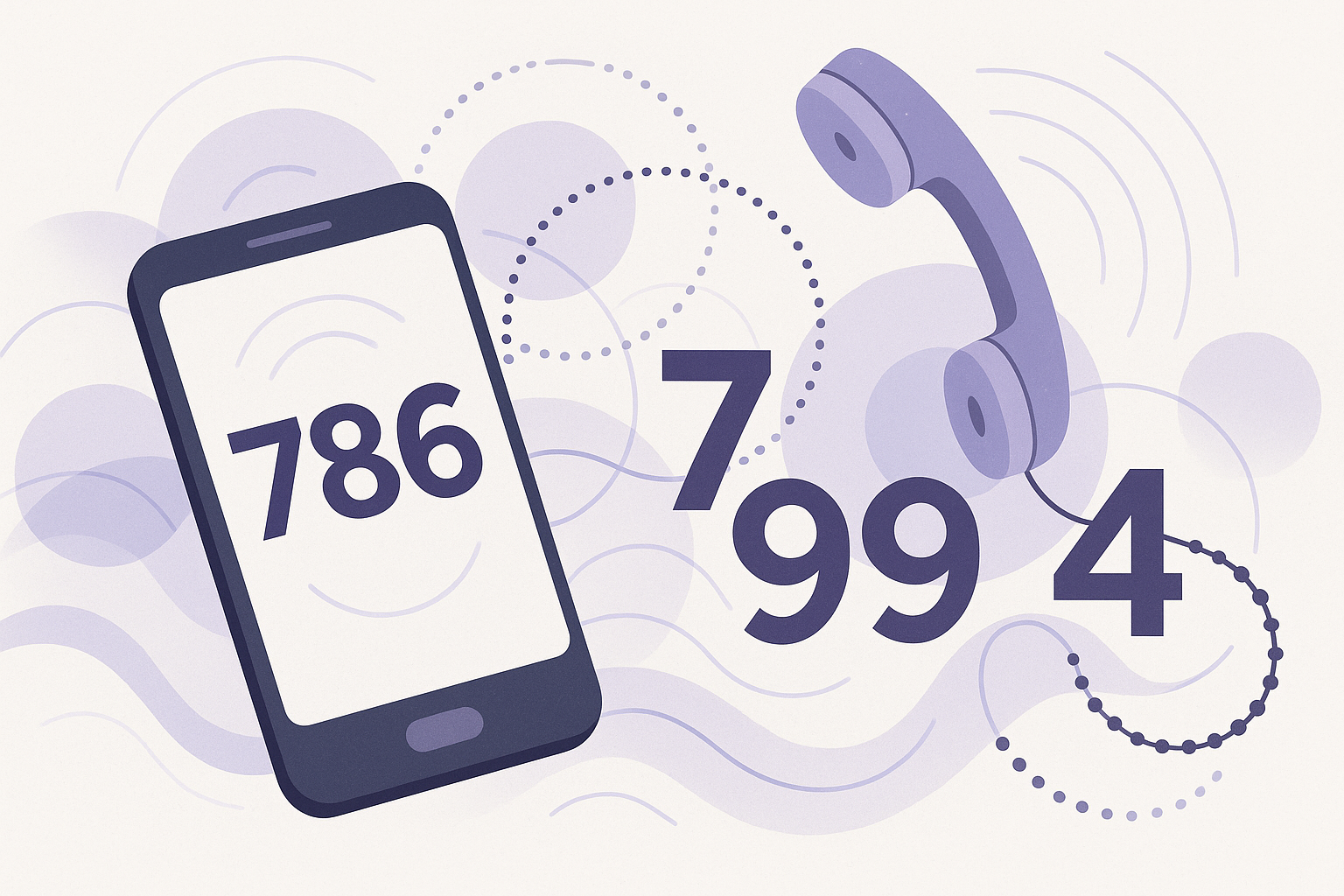
A taxi driver in Karachi won't part with his SIM card ending in 786 for any price. A license plate reading "99" in Dubai routinely fetches six figures at government auction. These aren't coincidences — they're the visible surface of a deep numerical tradition that runs through Islamic theology, Arabic script, and everyday Muslim life across dozens of countries.
The Story Behind 786
Arabic letters have always carried numerical values, a system called abjad that predates the adoption of the numerals we now call "Arabic." Each letter maps to a number. Add up the letters in Bismillah ir-rahman ir-rahim — the phrase that opens the Quran and precedes almost every significant act in Muslim life, translating roughly as "In the name of God, the Most Gracious, the Most Merciful" — and you land on 786.
That calculation made the number sacred by proxy. In South Asian Muslim communities especially — across Pakistan, India, Bangladesh, and the diaspora in the UK, the US, and Canada — 786 became a written substitute for the full Bismillah on letters, storefronts, and later, phone numbers. Writing the divine phrase on something that might be discarded or defiled was considered disrespectful; writing 786 sidestepped that concern while preserving the blessing.
The number carries genuine emotional weight. A phone number ending in 786 isn't just a pattern — for many customers it's a statement of identity and a daily reminder of faith.
Why 99 Is More Than a Number
Islam holds that God has 99 names (Asma ul-Husna), each describing a divine attribute: Al-Rahman (the Merciful), Al-Hakeem (the All-Wise), Al-Wadud (the Loving), and so on. Muslims recite them on prayer beads (tasbih) that traditionally come in counts of 33 or 99.
The number 99 is consequently one of the most coveted numerals in Arab Gulf markets. In the UAE, Saudi Arabia, Qatar, and Kuwait, low-digit and pattern-repeat license plate numbers are sold at public auction, and plates like "99" or "999" draw extraordinary bids because the religious resonance amplifies pure vanity appeal.
The same logic applies to phone numbers. A mobile ending in 9999, or carrying a 99 sequence in a prominent position, reads differently to an observant Muslim customer than it does to a secular Western buyer. The number carries a kind of baraka — blessing.
The Weight of 7 in Islamic Cosmology
Seven appears throughout Islamic tradition with a specificity that's hard to overstate:
- The Quran has 7 verses in its opening chapter, Al-Fatiha
- The Ka'ba in Mecca is circumambulated 7 times during Tawaf
- Pilgrims walk 7 times between the hills of Safa and Marwa
- There are 7 heavens described in Islamic cosmology
- Stones are thrown 7 times at each of the three pillars during Hajj
Seven also has broader Semitic roots — it's significant in Jewish and Christian tradition as well — but in an Islamic context the number is woven directly into the five pillars and ritual practice in a way that feels very concrete. It's not abstract mysticism; it's the counted steps of Hajj.
For phone number buyers, 7 is desirable in ways that compound with repetition. A number like 777-7777, or an area code pairing like 707 with a pattern-heavy local number, draws buyers who associate the digit with divine completeness, good fortune, or both.
How This Plays Out in Real Markets
Consider a business owner in the 973 area code (New Jersey, with a large Pakistani and Bangladeshi population) looking for a memorable number. A local number ending in 786-0786, or one that opens with 786, isn't just easy to remember — it signals community belonging instantly. Customers from that diaspora notice it. It builds trust before the first word is spoken.
In the Gulf, the economics are starker. The Abu Dhabi plate "1" sold for $14.3 million in 2008. Single and double-digit plates consistently clear millions at RTA Dubai auctions. Numbers incorporating 7, 99, or 786 punch well above their face value in these markets because two factors — exclusivity and spiritual resonance — stack on top of each other.
In the US market, demand for 786 numbers is concentrated in South Florida (Miami's area code is 786, which gives the pattern an organic local dimension), greater Houston, northern New Jersey, and the Chicago metro — all areas with substantial South Asian and Arab Muslim populations. A number ending in 786 in the 786 area code is essentially a double marker of identity, and sellers know it.
What Buyers Actually Look For
When Muslim buyers shop for premium numbers, the shortlist tends to cluster around a few specific patterns:
- 786 anywhere in the number, especially as a suffix or prefix
- 99 or 999 in suffix position
- Repeating 7s: 777, 7777, 77777
- Combinations like 786-9999 or 99-786
- Low-digit sequences (1, 11, 111) that echo the Islamic emphasis on divine unity (Tawhid)
Prices vary widely. A 786 suffix in a non-premium area code might list for a few hundred dollars. The same pattern in a high-demand market like 786 itself, or in 212, 310, or 800, can climb into the thousands.
Quick Takeaways
- 786 is the abjad numerical value of Bismillah ir-rahman ir-rahim, making it a sacred shorthand used widely in South Asian Muslim communities
- 99 references the 99 names of God and drives intense demand in Arab Gulf plate and phone number markets
- 7 is embedded in core Islamic ritual — Hajj, Tawaf, Al-Fatiha — giving it cosmological weight beyond simple luck
- Diaspora geography matters: Miami's 786 area code creates a natural overlap between sacred number and local identity
- Religious and cultural resonance can significantly lift the market value of a number beyond what pure memorability would justify
If you're looking for a number that carries meaning for you or your community — whether that's a 786 pattern, a run of 7s, or something else entirely — browse available numbers on GreatNumber to see what's currently on the market.