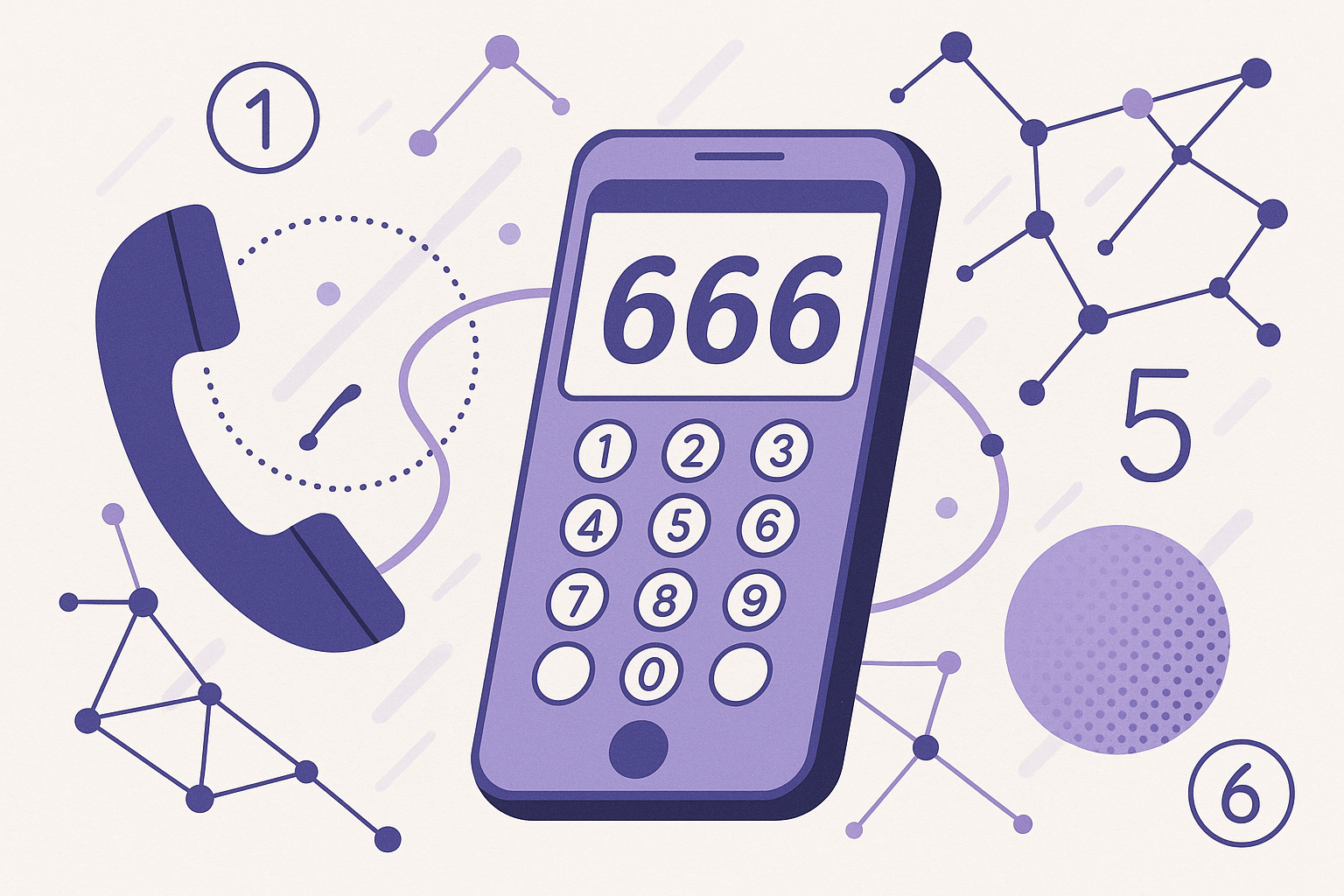
A stretch of Arizona highway once carried the designation US Route 666 — and for decades, the signs were stolen so relentlessly that the state gave up replacing them. In 2003, the road was officially renumbered US-491. The reason wasn't traffic logic. It was superstition.
Few numbers in Western culture carry as much baggage as 666. But cross the Pacific and those same three digits might appear on a storefront, a wedding invitation, or a premium phone number — deliberately chosen for good luck. Same number, completely different story.
Where the Fear Comes From
The "number of the beast" comes straight from the Book of Revelation, specifically chapter 13, verse 18: "Let the one who has understanding calculate the number of the beast, for it is the number of a man, and his number is 666." Biblical scholars generally believe this was a coded reference to a Roman emperor — most likely Nero Caesar — using a Hebrew practice called gematria, where letters carry numerical values.
The passage was probably written as political resistance literature, not a prophecy about modern phone numbers. But once it embedded itself in Western Christian culture, it stuck hard. By the medieval period, 666 had become a symbol of evil, the Antichrist, and apocalyptic doom — and that cultural imprint hasn't fully faded even in secular contexts.
Highways, License Plates, and the Great Rename
US Route 666 is the most famous casualty, but it's not alone. The highway was first designated in 1926 as a spur of Route 66 (six-six-six, three sixes — close enough for discomfort), and complaints never really stopped over its 77-year life. New Mexico, Arizona, Colorado, and Utah all shared the route at various points, and all eventually supported the renumber.
License plate requests tell the same story. Several US state DMV databases show consistent patterns of drivers rejecting plates that land on sequences ending in 666. In the UK, the Driver and Vehicle Licensing Agency has historically withheld certain 666 registrations from standard issue — not by law, but by administrative discretion after complaints.
Ronald Wilson Reagan — six letters in each name, some pointed out — reportedly asked his California address of 666 St. Cloud Road in Bel Air to be changed to 668 after leaving the presidency. Whether that story is apocryphal or not, it says something that it circulates at all.
The Phone Number Angle
Vanity and premium phone numbers with 666 are genuinely hard to sell in the United States. Even buyers who aren't personally religious tend to avoid them — the concern is customer perception. A toll-free number like 1-800-666-XXXX is almost impossible to market without irony unless you're in a niche where the edginess is the point (heavy metal merchandise, horror entertainment, that kind of thing).
Carriers have seen this in practice for years. Numbers with 666 in a prominent position — say, the first three digits of the local number — sit in inventory longer and often go for below-market rates despite otherwise clean patterns. The digits themselves are perfectly valid; the culture around them is the liability.
Where Six Is a Lucky Number
Here's the flip side. In Chinese numerology, 6 (六, liù) sounds similar to 流 (liú), meaning "to flow" — evoking smooth progress and things going well. Triple six, 666, therefore reads as a powerfully auspicious sequence: everything flowing, nothing blocked.
You'll find 666 on shop signs across mainland China, Hong Kong, and in Chinese diaspora communities in Southeast Asia. It appears in business names, on preferred license plates (which sell at auction for real premiums in China), and as a favored pattern in phone numbers. The contrast with Western avoidance couldn't be sharper.
This isn't unique to China. In broader East Asian contexts where 6 carries positive connotations — smooth, flowing, prosperous — the repetition amplifies the luck rather than triggering alarm. Tripling a lucky digit is considered a way to multiply the blessing, not corrupt it.
The Same Digits, Completely Different Logic
What this contrast reveals is that number superstitions are almost entirely about cultural encoding, not any property of the number itself. Six doesn't inherently mean anything. What matters is the story a culture has attached to it over centuries.
In the West, that story runs through Revelation, through medieval theology, through horror films like The Omen (1976), and through two thousand years of repetition. In parts of Asia, it runs through linguistic homophony and a tradition that treats smooth flow as a core aspiration. Neither is more rational than the other — both are simply inherited frameworks that feel true because everyone around you treats them as true.
A concrete example: in 2024, a triple-six license plate in Guangdong province sold at government auction for roughly ¥300,000 — equivalent to tens of thousands of US dollars. That same plate configuration in Texas would struggle to find a willing buyer at face value.
What This Means for Phone Numbers
For anyone choosing a business phone number, the cultural context of your market is real data, not soft preference.
- US/European markets: Avoid 666 in prominent positions unless your brand actively benefits from the edge. The friction is real even among non-religious customers.
- Chinese-American or broader Asian-American markets: 666 can work positively — or at least neutrally — depending on community context.
- International businesses: Know your audience. A number that plays well in Shanghai may raise eyebrows in Atlanta.
- Resale value: On the secondary market, 666-pattern numbers consistently underperform in Western countries relative to their digit quality.
The superstition premium is real, and it cuts both ways. Numbers that carry negative associations sell at discounts; numbers that carry positive ones command premiums. Understanding why helps you choose smarter.
Quick Takeaways
- 666 originates in the Book of Revelation as a coded political reference, likely to Nero
- US Route 666 was renamed US-491 in 2003 largely due to persistent public discomfort
- Phone numbers and license plates with 666 sell poorly in most Western markets
- In Chinese culture, 6 is lucky ("flowing/smooth"), making 666 a desirable triple
- The same number means opposite things depending entirely on cultural context
- Choosing a phone number for business means factoring in your specific market's number culture
If you're looking for a phone number that actually works for your brand and audience, browsing inventory by pattern is the smartest place to start. Search available numbers on GreatNumber — you'll find everything from triple-six listings to the most coveted repeating patterns in US area codes.