When Beijing scheduled the 2008 Summer Olympics to open at 8:08 PM on 08/08/2008, the government wasn't being cute. That date was chosen with deliberate precision because the Chinese lucky number 8 meaning runs deeper than superstition — it's woven into language, history, commerce, and daily life in ways most Western observers never fully grasp.
So let's go deeper than the usual two-paragraph answer.
Where the Belief Actually Comes From
The core reason is phonetic. In Mandarin, the word for 8 — bā (八) — sounds similar to fā (发), the first syllable of fācái (发财), which means "to prosper" or "to get rich." In Cantonese, the resemblance is even closer: baat rhymes tightly with faat, the Cantonese pronunciation of the same prosperity character.
This kind of sound-based meaning — called a homophonic association — is the engine behind most Chinese number beliefs. The number itself isn't magic; it's the word it sounds like that carries the power. Because fācái is one of the most culturally loaded phrases in Chinese (you hear it every Lunar New Year: Gōngxǐ fācái — "Wishing you prosperity"), any digit that echoes it gets elevated status.
Why Cantonese speakers often feel it most strongly
The homophonic link is strongest in Cantonese, which is why you see intense 8-preference behavior concentrated in Hong Kong, Guangdong province, Macau, and overseas Cantonese communities in cities like San Francisco, Vancouver, and Sydney. Mandarin speakers share the belief, but linguistically the rhyme is slightly looser — making the cultural transmission more learned than instinctive for younger mainland Chinese.
The Shape of 8 and Its Secondary Meanings
Beyond sound, the visual symmetry of 8 matters. The digit is perfectly balanced — top half mirrors bottom half — and in Chinese aesthetic thought, symmetry signals completeness and balance. The infinity symbol (∞) is just an 8 rotated sideways, and some practitioners of feng shui explicitly connect the endless loop to continuous, uninterrupted wealth flow.
Eight also holds significance in several traditional frameworks:
- The Eight Trigrams (Bāguà): The foundational symbols of the I Ching, used in feng shui and Chinese cosmology for over 3,000 years.
- The Eight Immortals (Bāxiān): A beloved group of Taoist figures, each representing a different human condition — their stories are everywhere in Chinese art and opera.
- Buddhism: The Noble Eightfold Path is central to Buddhist practice, giving 8 a sacred dimension across East and Southeast Asia.
None of these meanings caused the lucky association — the phonetic link did — but they reinforce it and give educated Chinese speakers multiple reasons to regard 8 favorably.
How Strongly Does It Shape Real Behavior?
Very strongly, and the evidence is measurable.
A study of real estate transactions in Vancouver found that homes with the digit 8 in their address sold at a statistically significant premium compared to similar properties without it. License plate auctions in Hong Kong have fetched tens of thousands of dollars for plates consisting of multiple 8s. Flight bookings, wedding dates, and business launch dates are routinely chosen to include 8.
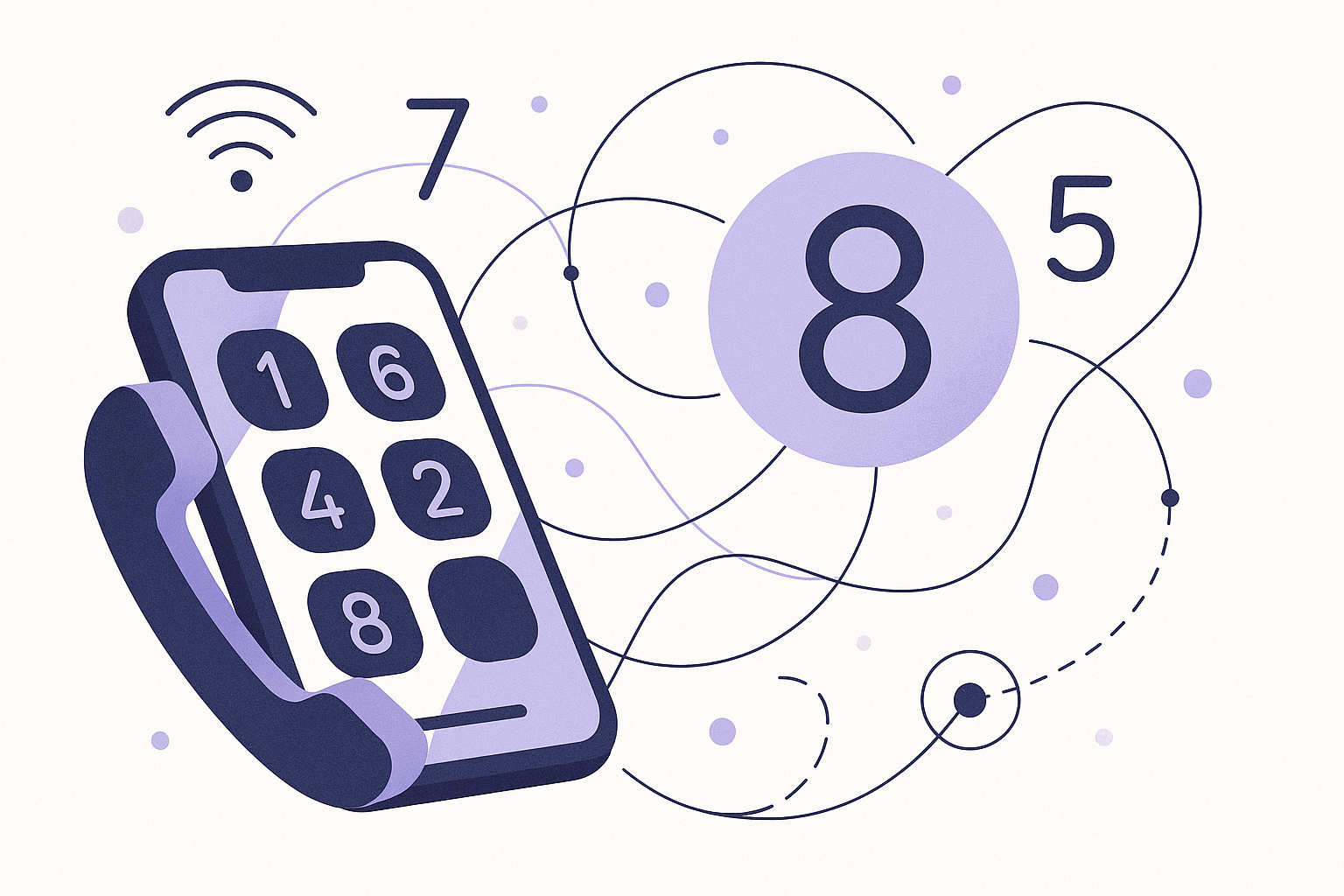
Phone numbers are perhaps the most visible arena. A number like 888-8888 or one ending in 8888 is considered extremely auspicious — four 8s in sequence is sometimes called a "great fortune" pattern. In Chinese communities, these numbers trade hands for serious money. A Chengdu businessman reportedly paid the equivalent of $270,000 for the mobile number 133-3333-3333 in part because of its repeated-digit prestige, and 8-heavy numbers command similar logic.
On the GreatNumber marketplace, US phone numbers packed with 8s — think 800 or 888 toll-free numbers with repeating 8 patterns, or local numbers in Chinese-community area codes like 626 (San Gabriel Valley), 408 (Silicon Valley), or 718 (Queens, NY) — consistently attract attention from buyers who know exactly what they're looking for.
The Rules That Make Some 8s Luckier Than Others
Not all 8s are equal. Here's how Chinese numerology typically ranks combinations:
- More 8s = better. 8888 outranks 888, which outranks 88, which outranks a lone 8.
- Position matters. An 8 at the end of a number (the "closing" digit) is considered especially strong because it's the last impression.
- Neighboring digits amplify or dilute. Pairing 8 with 6 (liù, sounds like liù = smooth/flowing) or 9 (jiǔ, sounds like "long-lasting") creates compound meanings like "long-lasting prosperity" (98) or "smooth wealth" (68). Pairing 8 with 4 (sì, sounds like death) largely cancels the good energy.
- Repeated sequences carry weight. A number like 8-8-8 doesn't just mean three times lucky — the repetition signals certainty and emphasis.
The most coveted patterns in Chinese numerology: 888, 168, 518, 688, and 998 — each carrying a layered spoken meaning when the digits are read aloud sequentially.
Does the Younger Generation Still Care?
Yes — perhaps surprisingly to outside observers. Survey data from mainland China and diaspora communities consistently show that millennial and Gen Z Chinese consumers still factor lucky numbers into phone number choices, business registrations, and even social media handles, even when they describe themselves as non-superstitious. The behavior has shifted from religious belief to cultural identity marker. Choosing an 8-heavy number is a way of signaling in-group awareness, aesthetic sensibility, and respect for family elders — whether or not you think it'll actually make you rich.
Quick Takeaways
- The Chinese lucky number 8 meaning is primarily phonetic — bā (8) sounds like fā, the root of "prosperity."
- The belief is strongest in Cantonese-speaking communities but is widespread across all Chinese cultures.
- Symmetry, Taoist symbolism, and Buddhist numerology give 8 secondary layers of meaning.
- More 8s, and 8 in the final position, are considered the most powerful configurations.
- Pairing 8 with 6 or 9 strengthens the lucky meaning; pairing it with 4 weakens it.
- Real premium prices — in real estate, license plates, and phone numbers — consistently reflect this preference.
If you're looking for a US phone number that carries the weight of an 8-heavy pattern — whether for a business serving Chinese-American customers or simply because you want a number that means something — browse the available inventory at GreatNumber and filter by digit pattern. The right number is specific; you'll know it when you see it.