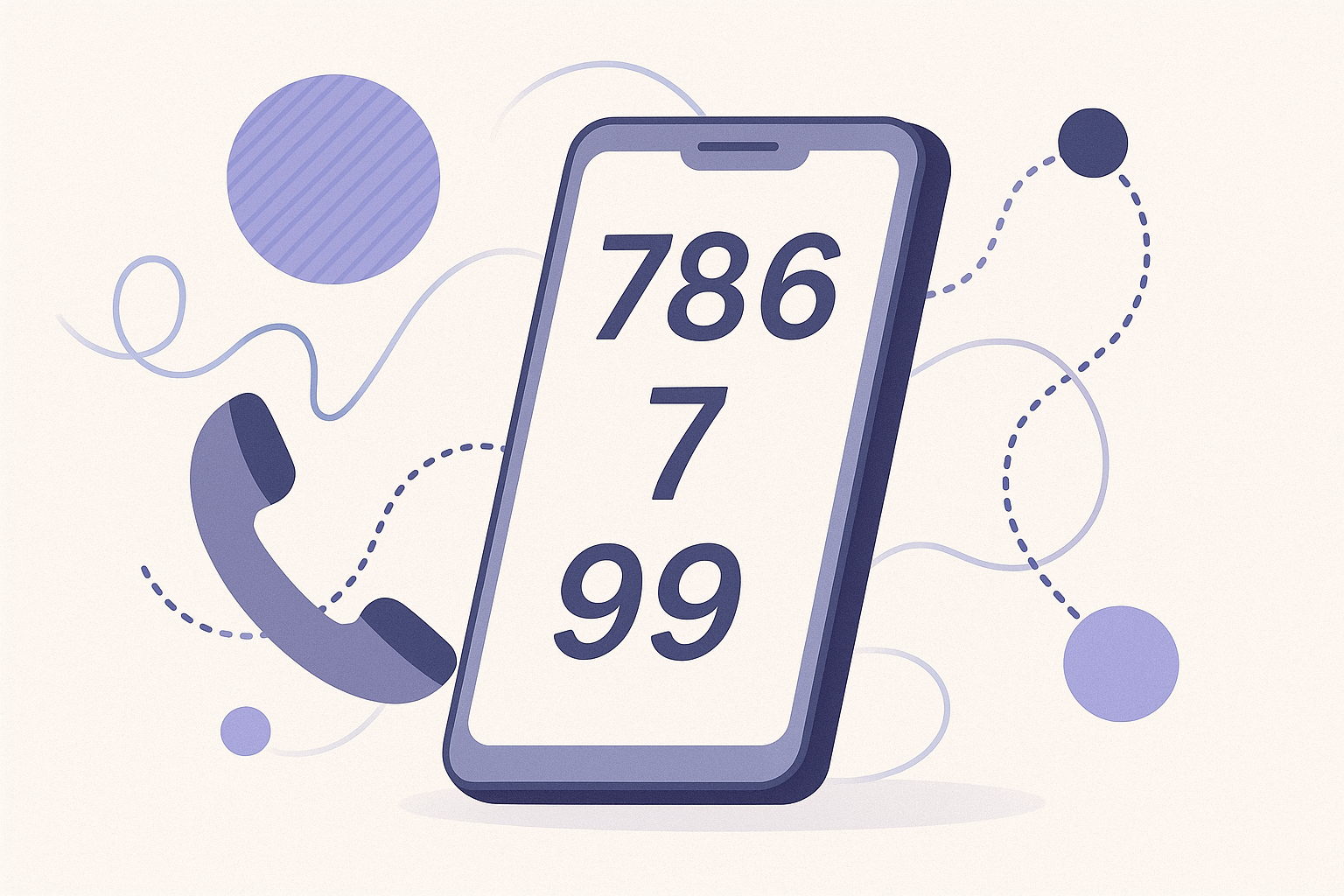
Walk into a South Asian restaurant in Birmingham, Bradford, or Brooklyn, and there's a decent chance you'll see "786" displayed somewhere near the entrance — on a sign, a sticker, sometimes hand-painted above the door. It's not a house number or a zip code. It's a blessing. And for hundreds of millions of Muslims worldwide, it carries the same weight as words from the Quran itself.
What 786 Actually Means
The number 786 is the abjad numerical value of the Arabic phrase Bismillah ir-Rahman ir-Rahim — "In the name of God, the Most Gracious, the Most Merciful." Abjad is an ancient alphanumeric system in which each Arabic letter corresponds to a number. Add up the letters in Bismillah, and you get 786.
Muslims begin almost every significant act — a meal, a journey, a business deal, a letter — with Bismillah. So 786 functions as a written shorthand for that invocation. It lets people put a sacred phrase on something physical — a phone number, a van's side panel, a license plate — without risking the Quran's Arabic text being defaced or disrespected.
786 is not a Quranic verse itself, but a numerological proxy for one of Islam's most-repeated phrases. That distinction matters. Some scholars caution that abjad numerology has pre-Islamic roots and isn't doctrinally endorsed — yet the practice is deeply embedded in South Asian Muslim communities in particular, stretching from Pakistan and Bangladesh to their global diaspora.
The Number 7 in Islamic Tradition
Seven appears throughout Islamic practice with striking regularity. It's not coincidence; it reflects a cosmology in which the number carries structural importance.
- The Quran describes seven heavens (referenced multiple times, including in Surah Al-Mulk)
- Pilgrims performing Tawaf at the Kaaba in Mecca circle it seven times
- During Sa'i — the ritual walk between the hills of Safa and Marwa — the distance is covered seven times
- The Quran itself consists of seven oft-repeated verses (Al-Fatiha, the opening chapter, has seven ayat)
- Hell, in Islamic scripture, has seven gates
For Muslims who place stock in numerology, a phone number or plate containing 777 or starting with 7 reads as propitious. In Arab Gulf countries — where vanity plates routinely sell at auction for six figures — a plate with a single digit or a repeating 7 commands serious money.
99 and the Names of God
Ninety-nine is perhaps the most theologically grounded number in all of Islamic tradition. The Prophet Muhammad (peace be upon him) is recorded in Sahih Bukhari as saying: "Allah has ninety-nine names, one hundred minus one. Whoever learns them will enter Paradise."
These 99 names — the Asma ul-Husna, or Beautiful Names — include Al-Rahman (the Compassionate), Al-Rahim (the Merciful), Al-Malik (the King), Al-Quddus (the Holy). Reciting them is a form of dhikr, remembrance of God. Counting them on prayer beads (misbaha) is a daily practice for millions.
A phone number ending in 99, or one that incorporates 99 prominently, carries an implicit nod to this tradition. It's the kind of detail that a Muslim business owner might actively seek when choosing a business number — not superstition exactly, but intentional resonance.
How This Shows Up on Phone Numbers and Plates
The practical expression of these beliefs is visible across industries and geographies.
In the UK, US, and Canada — countries with large South Asian and Arab Muslim communities — numbers containing 786 are among the most sought-after by Muslim buyers. A toll-free number like 1-800-786-XXXX or a local number opening with 786 carries an immediate cultural signal: this business understands its customer base.
In Gulf states like the UAE and Saudi Arabia, license plate culture around sacred numbers is particularly intense. A plate bearing "7" alone has sold at Dubai's Roads and Transport Authority auctions for millions of dirhams. Plates with "99" or "786" attract competitive bidding that would seem baffling without the cultural context.
Phone numbers follow the same logic. A business serving a Muslim-majority clientele that holds a number with 786 in it isn't just picking digits — it's advertising shared values before a single call is made.
A concrete example
A halal grocery chain operating out of Chicago's Devon Avenue — a corridor known informally as "Little India/Pakistan" — chose a local number ending in -0786 when it opened its second location. The owner later said the number drew immediate recognition from customers who called to confirm the address: several mentioned the number specifically, assuming the business was Muslim-owned before asking a single question. That's the kind of brand shorthand no logo redesign can replicate.
Choosing a Number That Carries Meaning
If you're building a business that serves Muslim communities — or if your own faith informs your brand identity — the number you answer on is worth thinking about more than most entrepreneurs do.
A few patterns worth noting:
- 786 as a prefix or suffix (e.g., 786-XXXX or XXX-0786)
- 99 embedded mid-number or as a closing pair
- 7 as a repeating digit (777, 7777)
- Combinations like 7-99 or 99-7 within a 10-digit string
These aren't arbitrary. They carry weight with specific communities in ways that generic "easy to remember" numbers simply don't.
Quick takeaways
- 786 is the abjad numerical value of Bismillah ir-Rahman ir-Rahim, Islam's most-spoken invocation
- 7 appears throughout Islamic ritual — in pilgrimage rites, in Quranic structure, in descriptions of the cosmos
- 99 refers to the Beautiful Names of God (Asma ul-Husna), one of Islam's most practiced forms of devotion
- Numbers carrying these digits are actively sought by Muslim business owners and individuals worldwide
- In Gulf states, plates and numbers with sacred digits command premium prices at auction
- The practice is most prominent in South Asian Muslim communities but extends across the global Muslim diaspora
If you want to find a phone number that reflects these traditions — or simply one that resonates with the community you serve — browse the inventory at GreatNumber. Filtering by pattern lets you search for specific digit combinations, including 786, 99, and 777.