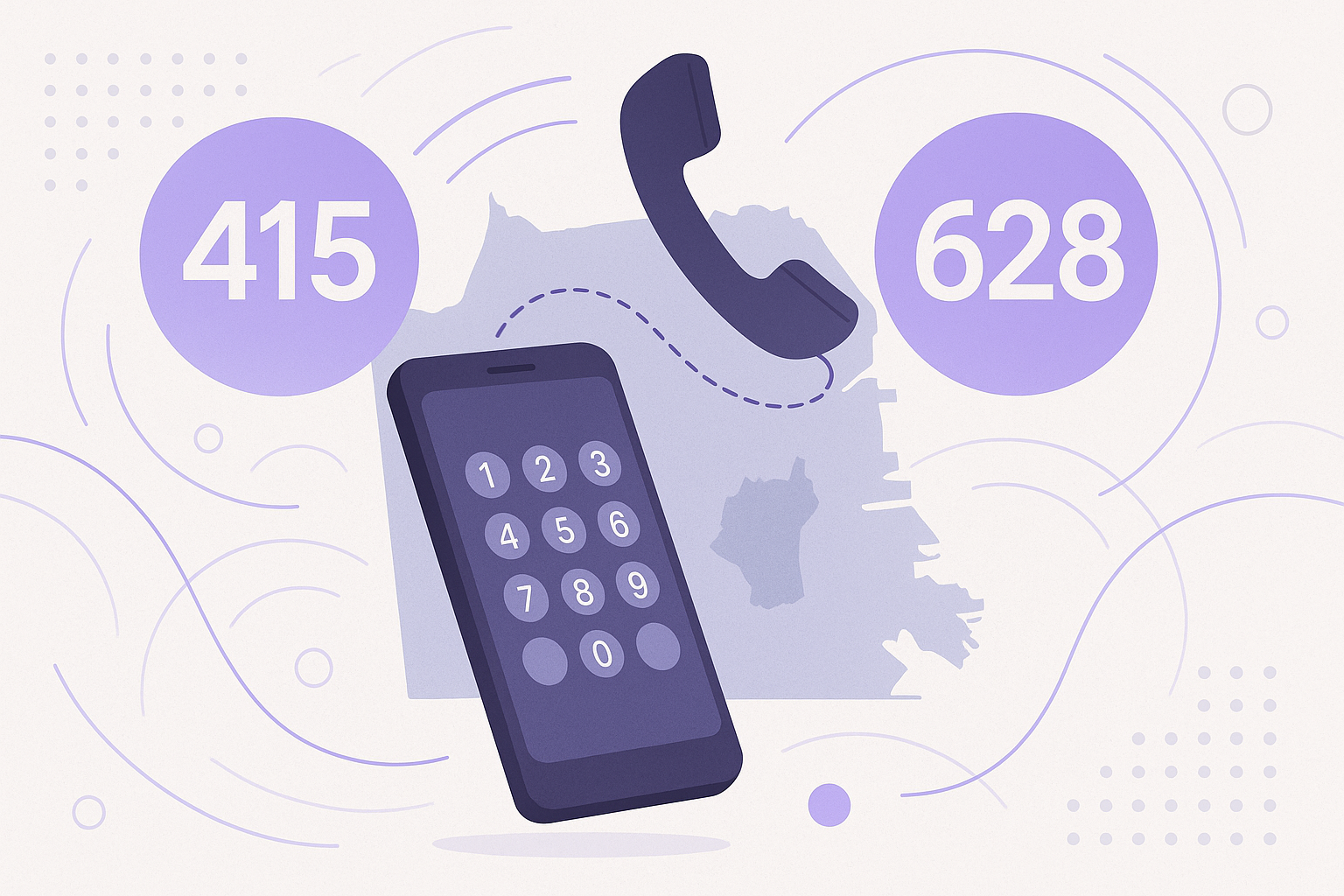
Call a San Francisco law firm, a legacy bank, or a decades-old restaurant in the Mission, and you'll almost certainly see a 415 area code light up your phone. Pull up a newer startup or a mobile-first business in the same zip code, and you're just as likely to see 628. The 415 vs 628 San Francisco area code question isn't just trivia — for businesses especially, the answer has real consequences for how customers perceive you before you even pick up.
A Quick History of Both Area Codes
San Francisco's telephony story starts with 415. When AT&T carved the country into North American Numbering Plan (NANP) zones in 1947, California got just three codes: 213, 415, and 916. That original 415 blanketed everything from San Francisco down the Peninsula and across the Bay. It was, effectively, the California tech and finance code for decades.
By the mid-1990s, the explosion of fax machines, pagers, and early internet dial-up lines was eating through available number inventory fast. In 1999, the 650 split off to serve the Peninsula (Palo Alto, Menlo Park, Redwood City), shrinking 415 to San Francisco proper and Marin County. That boundary held until 2015, when the California Public Utilities Commission introduced 628 as an overlay for the same geographic territory.
An overlay means 628 doesn't carve out a new physical region. It sits on top of 415's existing footprint — same cities, same neighborhoods, same streets. The difference is purely administrative: new number subscribers who couldn't get a 415 number started receiving 628 instead.
The Prestige Gap Is Real
Ask anyone who's lived in San Francisco more than a decade: 415 carries weight. It signals longevity. A business with a 415 number has been around long enough — or was intentional enough — to secure one. That matters in industries where trust is the product.
415 numbers are perceived as:
- Established, locally rooted, San Francisco–native
- More prestigious for professional services (law, finance, medicine, real estate)
- Harder to obtain, which itself confers a degree of exclusivity
628 numbers are perceived as:
- Newer, often mobile-assigned
- Perfectly functional and still genuinely local
- More common among startups, solo operators, and businesses launched after 2015
Neither is "fake." The 628 is a real San Francisco number in every technical sense. But perception is part of the product, and right now 415 wins that round.
Coverage: Where Each Code Actually Works
Because 628 is a straight overlay of 415, both codes cover identical geography. The core territory includes:
- San Francisco city and county (all neighborhoods — SoMa, the Tenderloin, Pacific Heights, the Sunset, Bayview, everywhere)
- Marin County — Sausalito, Mill Valley, San Rafael, Novato
- A small slice of southern Sonoma County that falls within the 415/628 overlay boundary
One practical wrinkle: because 628 arrived as an overlay, the CPUC mandated 10-digit dialing within the 415/628 region. You can't just dial seven digits locally anymore — you need the full area code + number. That's been standard practice long enough that most residents don't think twice about it, but it's worth knowing if you're configuring a phone system.
Which One Should Your Business Choose?
If prestige and longevity matter — go 415
Professional services firms, retail shops with a neighborhood identity, restaurants, healthcare providers, and anyone whose customers are older or less tech-native will benefit from a 415. The number signals roots. It says you were here before the latest wave.
If availability and cost are your constraints — 628 works fine
Tech startups, app-based services, newer businesses, and companies whose customers are younger or primarily digital-first won't lose much by having a 628. Your Google Business Profile still shows San Francisco. Your customers still see a local number. The perception gap narrows every year as 628 becomes more common.
For vanity numbers, the calculus shifts entirely
A memorable vanity number — say, 415-NEW-CARS or 628-GET-HELP — can outperform a plain 415 number just on recall value. Pattern numbers (like 415-555-5500 or 628-888-8800) also punch above their weight in advertising. In those cases, the specific code matters less than the digit pattern itself.
A Concrete Example
Consider two competing San Francisco real estate brokerages. Brokerage A has held 415-920-XXXX since 2003 and prints it on every yard sign in Pacific Heights. Brokerage B launched in 2020 with 628-431-XXXX. On raw legitimacy, Brokerage A's 415 signals tenure to buyers who've been in the market for years. But if Brokerage B upgrades to a vanity number like 628-BUY-HOME, they close that gap fast — because the pattern is what sticks in a buyer's head, not the prefix.
The bottom line: 415 > 628 on prestige alone, but a great 628 number beats a forgettable 415 every time.
Quick Takeaways
- 415 is the original San Francisco area code, dating to 1947; 628 is an overlay introduced in 2015
- Both codes cover the same geography: SF proper and Marin County
- 415 carries more prestige — it signals an established, locally rooted business
- 628 is fully legitimate and increasingly common; the perception gap is narrowing
- 10-digit dialing is required within the 415/628 overlay territory
- For businesses, a memorable vanity or pattern number can matter more than which prefix you land
- 415 numbers are scarcer and typically cost more on the secondary market — sometimes significantly more
If you're trying to land a specific San Francisco number — whether that's a classic 415 or a well-patterned 628 — browsing by area code is the fastest way to see what's actually available. You can search both codes side by side at GreatNumber's area code directory and filter by pattern, word, or number sequence to find something worth putting on a business card.