A restaurant owner in Flushing, New York once paid four times the going rate for a local phone number ending in 8888. His competitors thought he was throwing money away. His regulars thought it was the smartest thing he ever did. That gap in perception is exactly what Chinese lucky-number culture looks like from the outside — and why it matters so much to anyone buying or selling phone numbers.
Sound Is Everything
Chinese numerology isn't mystical in the Western sense. It's phonetic. A digit is lucky or unlucky based on how its spoken name sounds in Mandarin, Cantonese, or both. That's the whole engine. Once you understand that, every pattern makes immediate sense.
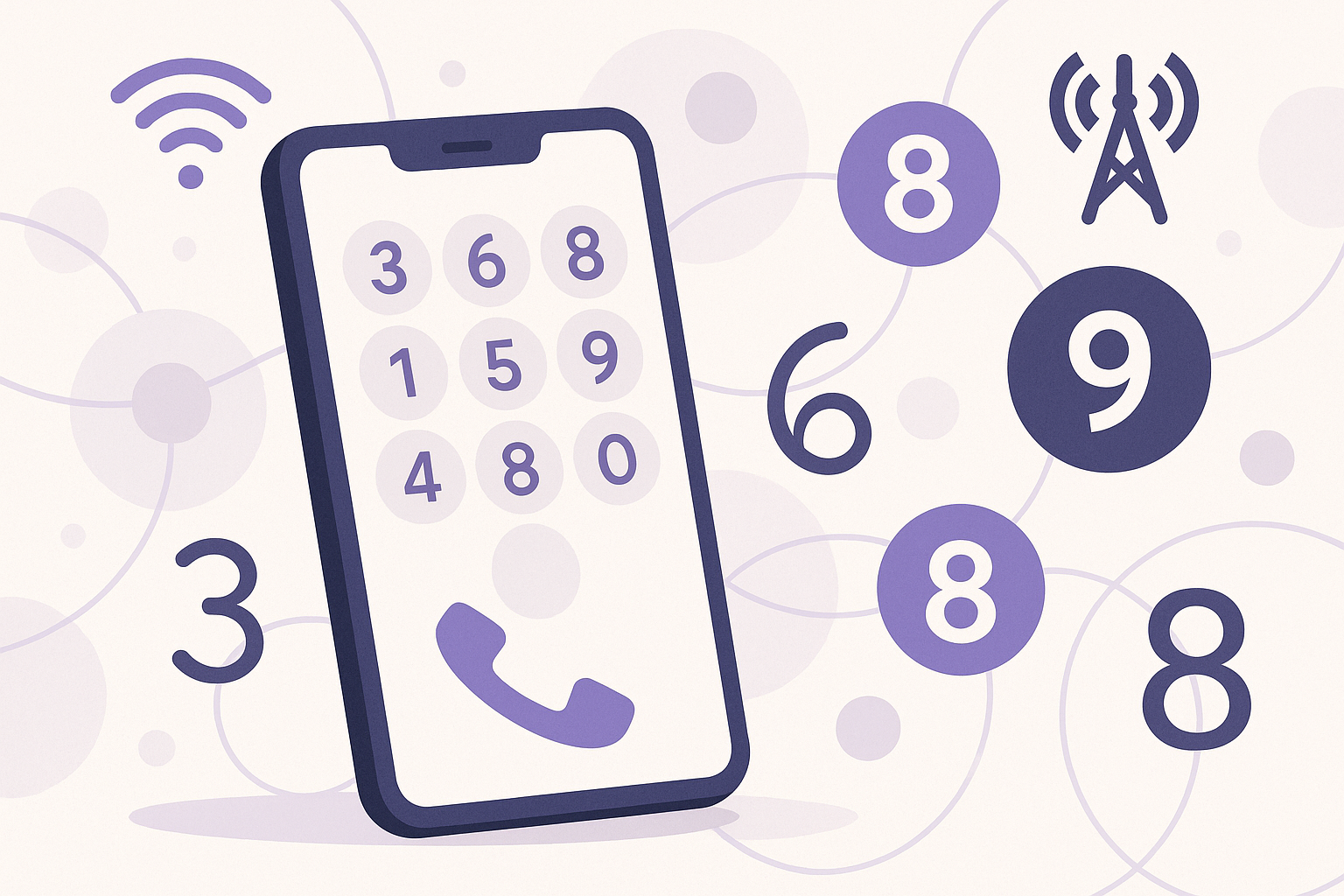
The digit 8 (八, bā) sounds close to 发 (fā), the verb in 发财 — "to become wealthy." It's the single most sought-after digit in Chinese phone-number culture, full stop. A string like 888 doesn't just sound good; it sounds like "wealth wealth wealth." That's why numbers with heavy 8 content consistently sell at the top of the vanity market, sometimes reaching five figures for the right pattern in the right area code.
6 (六, liù) rhymes with 溜 and 顺 — both meaning "smooth" or "flowing without friction." A life or business that flows without friction is the aspiration. Sixs show up constantly in auspicious strings, sometimes rivaling 8 in practical popularity because they're slightly less expensive to acquire.
9 (九, jiǔ) sounds like 久 (jiǔ), meaning "long-lasting" or "enduring." It carries connotations of longevity — a permanent marriage, a business that outlasts competitors, a relationship that doesn't end. You'll find 9 used heavily in wedding-adjacent businesses and in personal numbers meant to be kept for life.
The Digit You Won't See in Elevator Buttons
4 (四, sì) sounds nearly identical to 死 (sǐ), the word for "death." In many Chinese-owned buildings across the U.S., you won't find a fourth floor — the button goes from 3 to 5. The same logic applies to phone numbers. A number loaded with 4s is genuinely difficult to sell into Chinese-American markets, regardless of how clean or memorable the pattern is. Businesses targeting Chinese-speaking customers actively avoid area codes or suffixes that land heavy on 4.
This isn't superstition in the way outsiders sometimes frame it. It's audience awareness. A nail salon in the San Gabriel Valley with a number ending in 444 is starting the customer relationship at a disadvantage before anyone picks up the phone.
The Combos That Actually Get Searched
Individual digits matter, but combinations carry specific meanings — and those meanings are widely understood across generations.
- 168 — Pronounced yī-liù-bā, it sounds like 一路发 (yī lù fā): "prosperity all the way" or "wealth along the whole road." This is one of the most commercially valued three-digit sequences in the market.
- 888 — Triple wealth. No translation needed for most buyers. Premium pricing, high demand, quick turnover.
- 1314 — Sounds like 一生一世 (yī shēng yī shì): "one lifetime, one world" — i.e., forever. Enormously popular for personal numbers, couple-owned businesses, and wedding vendors.
- 518 — 我要发: "I will prosper." A natural fit for new business launches.
- 528 — 我爱发: "I love wealth." Lighter, playful, still positive.
- 9999 — Longevity stacked four times. Less flashy than 8888 but deeply valued in certain Cantonese-speaking communities.
The least desirable endings, beyond 4, include strings heavy on 1 (alone, single — neutral to slightly negative in some contexts) and 7 (sometimes associated with death in Cantonese, though far less consistently than 4 in Mandarin).
What This Looks Like in a Real Purchase Decision
Say a Mandarin-speaking acupuncturist is setting up a new practice in a city with the 626 area code — the San Gabriel Valley, one of the largest Chinese-American communities in the country. She has two numbers available at similar prices:
- 626-518-8866
- 626-741-4400
The first reads as flowing wealth and smooth success. The second has two 4s and ends flat. For her target clientele, those aren't equivalent choices. One is a business asset. One is a liability she'll have to explain away.
That's the practical weight Chinese numerology carries in phone number buying.
Regional Nuance Worth Knowing
Mandarin and Cantonese pronunciations diverge enough that some digits shift in value by community. In Cantonese, 2 (二, yi) can sound like "easy," adding a small positive boost. 3 in Cantonese (三, saam) sounds close to "life" (生, saang) — neutral to positive. These differences are real but secondary to the major digits above, which hold consistent value across both dialects.
If you're buying a number specifically for a Cantonese-speaking market — think San Francisco's Richmond district, parts of New York's Chinatown — it's worth going one layer deeper into the phonetics before finalizing.
Quick Takeaways
- 8 is the king digit — sounds like "wealth," drives the highest premiums
- 6 means smooth sailing — nearly as desirable, often more affordable
- 9 signals longevity — strong for personal use and relationship-focused businesses
- 4 is genuinely avoided — sounds like "death" in Mandarin; a real sales barrier
- Combos like 168, 1314, and 888 carry specific meanings that buyers recognize immediately
- Regional dialect differences (Mandarin vs. Cantonese) can shift the value of secondary digits like 2 and 3
If you're shopping for a number that resonates with Chinese-speaking customers — or you just want to understand why certain patterns command the prices they do — browsing by digit pattern is the fastest way to see what's available. You can search by area code and number pattern at GreatNumber to find combinations that align with the numerology your customers already believe in.